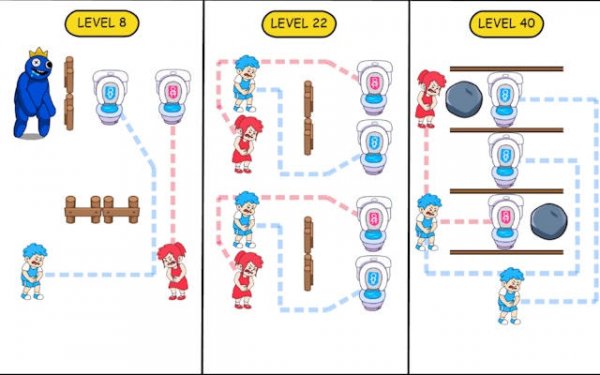
Core Drawing Mechanic
Players use their finger or mouse to sketch continuous lines that connect each character to its matching destination. The primary rule is simple: no two lines can cross or touch, and characters cannot collide along their routes. This constraint transforms a straightforward drawing task into a layered logic problem where every stroke must be intentional. Early puzzles provide clear space to experiment, while later stages demand precise planning to weave paths around obstacles and other routes.
Progressive Challenge Design
The difficulty curve introduces new elements gradually. Initial levels feature just two or three characters with open layouts, allowing players to understand the basic flow. As progress continues, additional characters appear, destinations shift to more distant positions, and barriers such as walls or gaps force longer, more intricate lines. Each stage feels like a fresh spatial puzzle rather than a repetitive task, keeping the experience engaging without overwhelming the player.
Visual Appeal and Tone
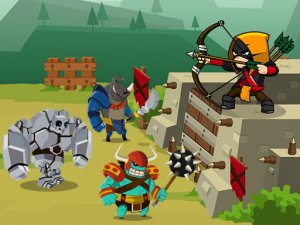
The game uses bright, cheerful colors and friendly character sprites that make the puzzles feel approachable. This visual style helps reduce the mental pressure often associated with logic games, making it suitable for younger players and adults alike. The playful theme of directing characters to restrooms adds a lighthearted layer that contrasts nicely with the cognitive effort required, creating a balanced and enjoyable atmosphere.
Session Structure and Pace
Each puzzle can be completed in a few minutes, making the game ideal for short breaks or casual play sessions. There is no timer or score pressure, so players can think through each move at their own speed. The arcade-like format encourages attempting multiple puzzles in a row, driven by the satisfaction of finding a clean solution. This structure supports both quick, relaxed play and longer focused sessions.
Cognitive Benefits
Beyond entertainment, the game exercises spatial reasoning and sequential planning. Players learn to visualize entire routes before drawing, anticipate potential conflicts, and adjust strategies when initial plans fail. These skills are valuable for children developing problem-solving abilities and for adults seeking a gentle mental workout. The game provides a low-stakes environment to practice thinking ahead and adapting to constraints.






Comments
0 comments